
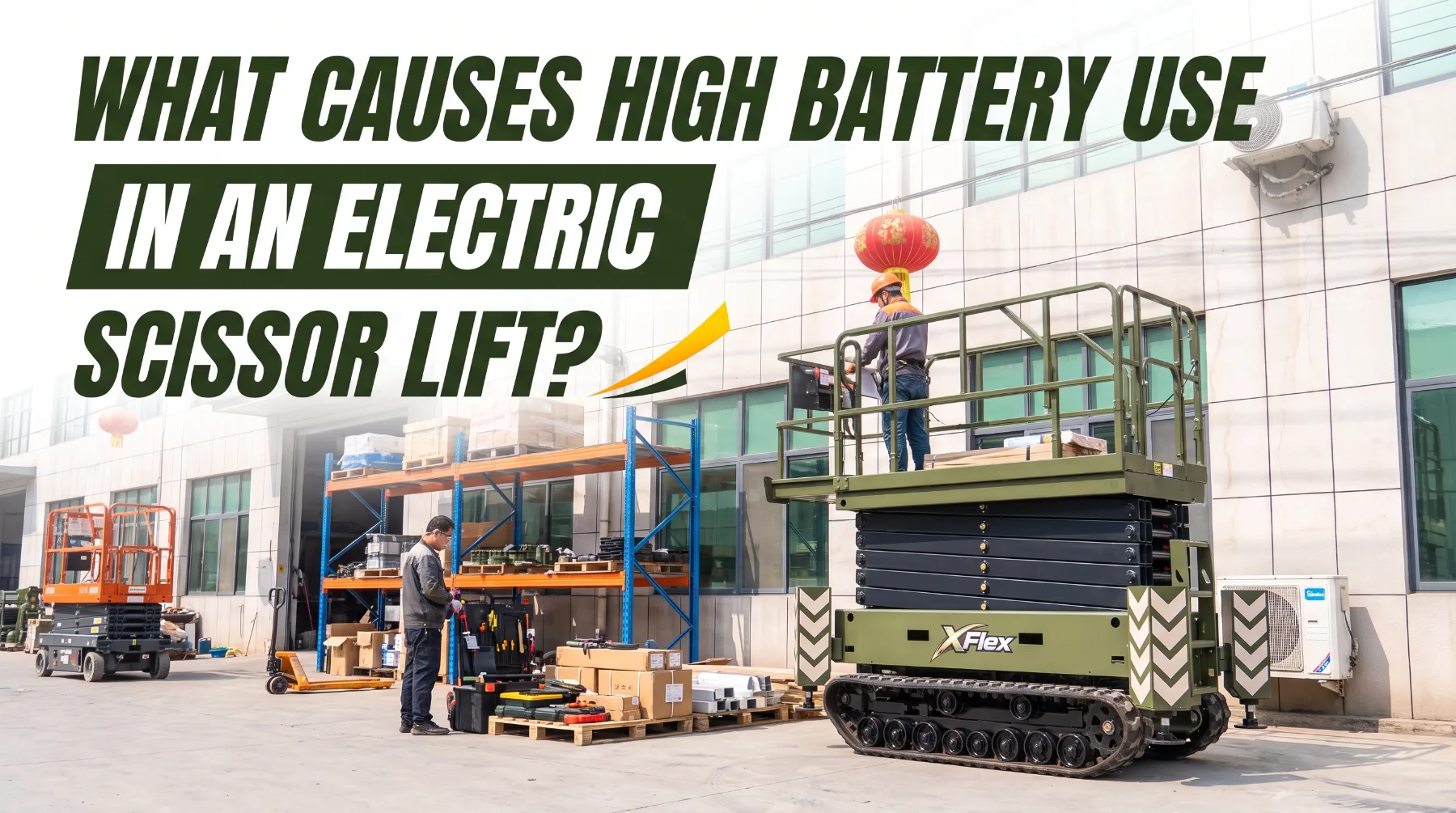
An electric scissor lift's battery consumption increases when the drive motors, lifting system, and auxiliary electrical components require more power during operation. Frequent lifting, heavy platform loads, long travel distances, acceleration, inclines, and rough surfaces can increase motor current and energy use, reducing the available runtime from each charge. Battery condition also affects usable capacity, while low temperatures, incorrect charging practices, and electrical or mechanical faults can reduce the amount of stored energy available for productive work. High consumption is therefore usually the result of operating demand combined with battery condition and machine efficiency rather than a single fault.
The main causes can be traced to how much work the lift performs during each duty cycle and how efficiently the machine converts stored electrical energy into movement. Repeated elevation cycles increase lifting energy demand, while unnecessary travel and frequent starts and stops increase traction motor load. Excessive platform weight can further increase the energy required for lifting and travel, and poor tire condition or mechanical resistance can add unnecessary load to the drive system. Keeping loads within the rated capacity, reducing unnecessary travel, maintaining tires and mechanical components, following proper charging procedures, and servicing the battery and electrical system can help control energy consumption. Managing these factors together allows more of the battery's stored energy to be converted into productive operating time.
How the Battery Powers the Lift
Before digging into the causes, it helps to know where the energy goes. An electric scissor lift runs two main draws off its battery: the hydraulic system that raises and lowers the platform, and the drive motors that move the machine across the ground. Every function you use taps the same power source.
The battery discharges in proportion to how hard those systems work. A light task on level ground sips power slowly, while heavy lifting or hard driving pulls current fast. Keep that principle in mind, because nearly every cause of high battery use below comes down to one thing: making the hydraulics or drive motors work harder than they need to.
Frequent Lifting and Lowering Cycles
Raising the platform is one of the most energy-intensive things a scissor lift does. The hydraulic pump draws a heavy burst of current every time it lifts the platform and its load against gravity. The more often you cycle up and down, the more of those demanding bursts the battery has to supply.
Consider a job where an operator raises the platform, works briefly, lowers it to reposition, then lifts again, repeating this dozens of times an hour. Each lift is a fresh peak draw, and those peaks add up quickly across a shift. A smarter approach is to plan the work so the platform stays at a stable height for longer stretches, reducing the number of full lift cycles.
Common mistake: Repositioning at full height by lowering completely and re-lifting for every small move. Where safe and practical, minor repositioning at a lower travel height saves the battery from repeated peak-draw cycles.
Heavy Load Weights
Load weight has a direct effect on how hard the hydraulic system works. The heavier the combined weight of workers, tools, and materials on the platform, the more current the pump needs to raise it. A lift carrying near its rated capacity will drain the battery noticeably faster than one carrying a light load.
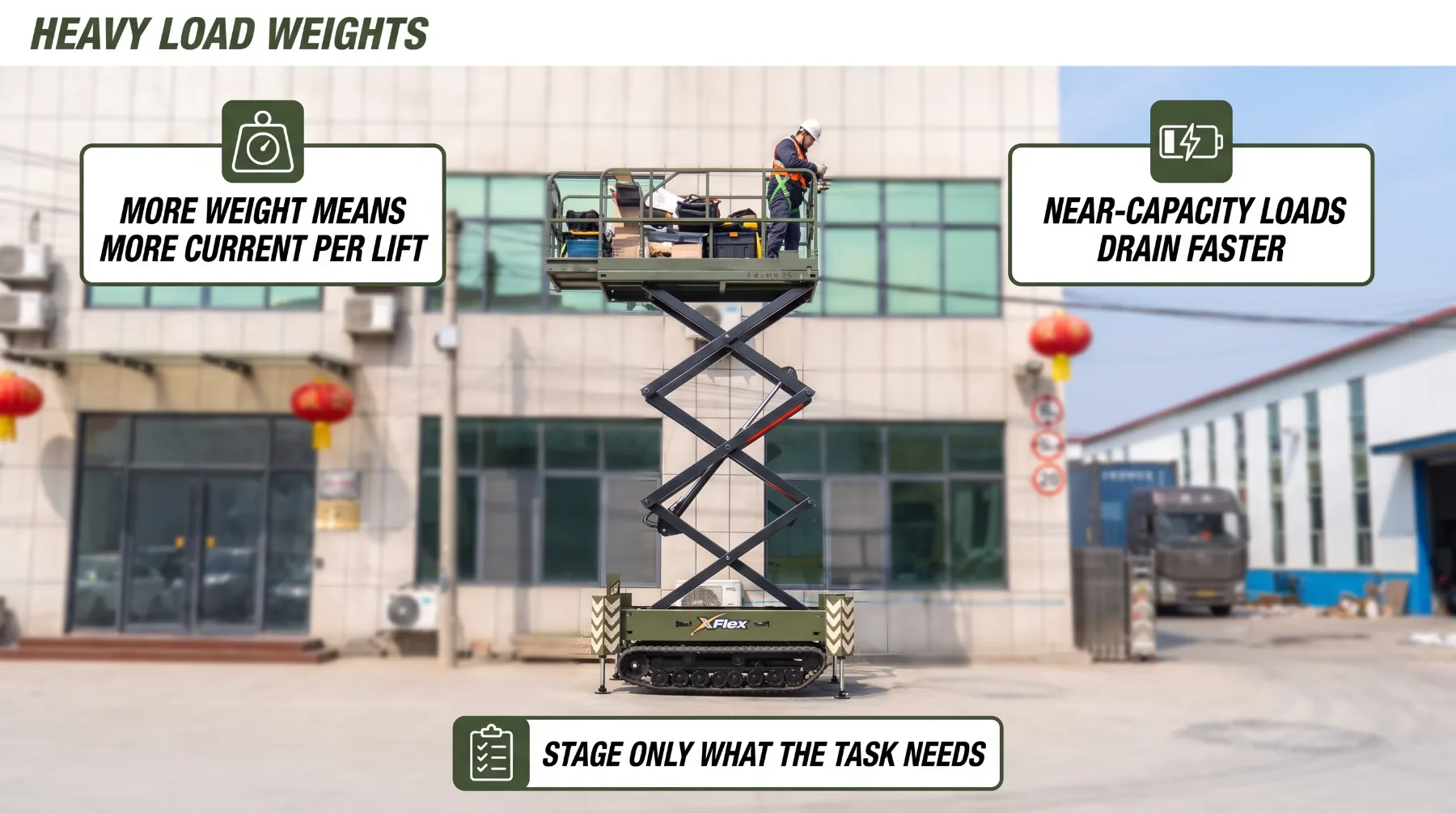
The relationship is straightforward: more weight means more resistance, and more resistance means more energy per lift. This is why overloading, beyond the safety risk it creates, also quietly shortens runtime. Keeping loads sensible and within the machine's rated capacity protects both the operator and the battery.
In practice, staging only the tools and materials needed for the immediate task, rather than loading the platform heavy "just in case," keeps each lift cycle efficient and stretches the charge further.
Driving on Inclines or Rough Terrain
Moving the machine draws on the battery just as lifting does, and the ground underneath changes that demand dramatically. Driving across smooth, level concrete asks little of the drive motors. Climbing a ramp, crossing a slope, or pushing through gravel, dirt, or debris forces those motors to work much harder, pulling far more current.
Inclines are especially demanding because the motors fight gravity the entire climb. Rough or soft terrain adds rolling resistance, so the machine burns extra energy just to keep moving. A lift used mostly outdoors on uneven ground will consistently show higher battery use than one working on a flat indoor floor.
Common mistake: Taking the longest or roughest route across a site out of habit. Planning smoother, flatter travel paths, and minimizing unnecessary driving, reduces the load on the drive system and preserves runtime.
Cold Temperatures and Battery Performance
Temperature has a strong effect on battery capacity, and cold weather is a frequent hidden culprit behind poor runtime. The chemical reactions inside a battery slow down as temperatures drop, which reduces the amount of usable energy the battery can deliver. A pack that runs a full shift in summer may fall noticeably short on a cold winter morning.
This means the battery isn't necessarily failing, it's simply delivering less in the cold. Operators often misread this as a worn-out battery when the real issue is the environment. Storing the machine in a heated or sheltered space overnight, and allowing the battery to warm before heavy use, helps recover much of that lost capacity.
In freezing conditions, expect shorter runtime and plan charging and battery swaps accordingly rather than being caught short mid-task.
Battery Age and Degradation
Every battery loses capacity as it ages, and an older pack is one of the most common reasons a lift no longer holds a charge the way it once did. Over hundreds of charge and discharge cycles, the battery's ability to store energy gradually declines. A pack that once powered a full shift may eventually manage only part of one.
Degradation accelerates when a battery has been treated poorly, repeatedly deep-discharged, left uncharged, or overworked. At a certain point, no charging habit will restore its original runtime, and replacement becomes the sensible choice.
In practice: If a well-charged battery drains far faster than it did when new, and other causes are ruled out, age is the likely answer. Tracking each battery's runtime over time helps you spot decline early and plan replacements before they disrupt work.
Improper Charging Habits
How a battery is charged has a lasting effect on both daily runtime and long-term health. Interrupting charge cycles, topping off in short bursts, or failing to fully charge the pack before a shift all leave the lift starting the day with less than a full tank. Over time, poor charging habits also speed up the degradation described above.
For many lead-acid batteries, consistent full charge cycles and proper maintenance, including correct watering where required, keep the pack healthy and deliver full capacity. Skipping these steps compounds into shorter runtime and a shorter battery lifespan.
Common mistake: Pulling a machine off the charger early to get it back into service. Allowing a complete charge cycle, and following the manufacturer's charging guidance, protects both today's runtime and the battery's future.
Operator Behavior
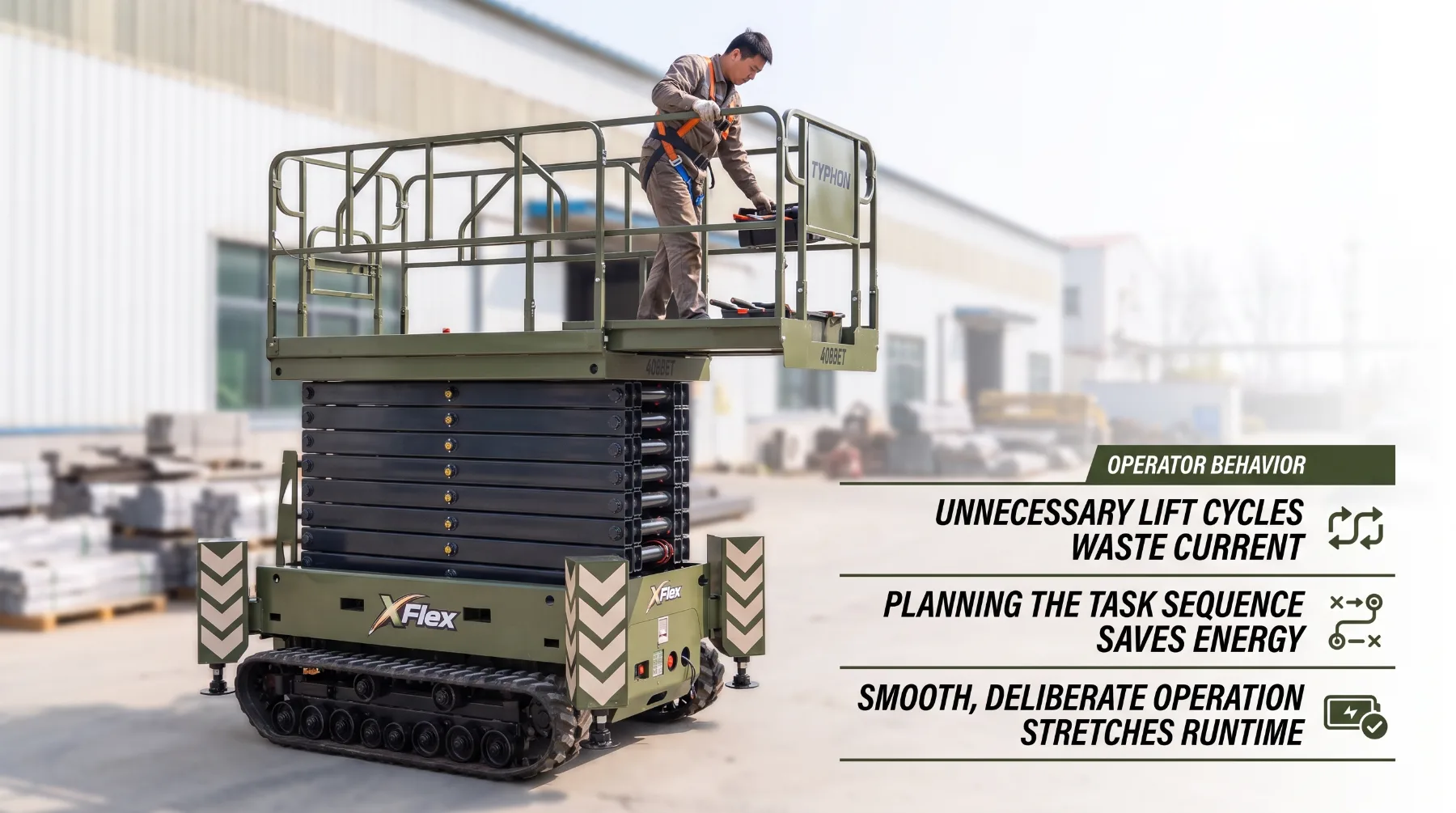
Finally, the person running the machine has a real influence on how fast the battery drains. Aggressive, inefficient operation, unnecessary lift cycles, driving farther than needed, running functions harder than the task requires, all pull extra current the work never demanded. Two operators on identical machines can post very different runtimes simply through how they work.
Smooth, deliberate operation makes the difference. Planning the sequence of tasks, minimizing repositioning, driving efficient routes, and avoiding needless raising and lowering all keep the battery working only as hard as the job truly requires. This costs nothing but attention, and it's often the fastest way to recover lost runtime.
Coaching operators on efficient habits pays back immediately, because good technique protects the battery on every task without slowing real production.
Conclusion
High battery consumption in an electric scissor lift is primarily determined by the electrical power required by the hydraulic lift system and traction motors, with total energy use increasing as load, operating time, and duty-cycle intensity increase. Platform lifting requires higher hydraulic pressure as payload increases, which raises motor current and electrical power demand, while repeated lift cycles accumulate energy consumption over the shift. Travel on inclines, rough or uneven surfaces, and high-resistance terrain increases traction motor torque and current draw, further reducing available battery capacity. Ambient temperature also affects battery performance because low temperatures can reduce available capacity and increase internal resistance, while battery aging gradually reduces energy storage capacity and power delivery capability. Charging practices influence long-term battery condition, particularly when the battery is repeatedly undercharged, exposed to excessive heat, or operated outside the manufacturer's recommended charging limits. Operator behavior affects consumption through acceleration rate, travel speed, unnecessary repositioning, repeated lift cycles, and inefficient route selection. Runtime should therefore be evaluated using payload, lift frequency, travel distance, terrain, grade, ambient temperature, battery age, charging history, and duty cycle rather than battery capacity alone. Proper battery maintenance, adherence to the recommended charging procedure, efficient hydraulic and drivetrain operation, and controlled operator technique can reduce unnecessary energy demand and help preserve usable capacity. If runtime remains significantly below the expected operating period after confirming the charging system and duty cycle, battery capacity loss or increasing internal resistance may indicate that the battery requires testing or replacement.
Frequently Asked Questions
Why does my electric scissor lift battery drain faster in winter?
Cold temperatures slow the chemical reactions inside the battery, which reduces the amount of usable energy it can deliver. A pack that comfortably runs a full shift in warm weather can fall noticeably short on a freezing morning, even when fully charged. This is normal battery behavior, not necessarily a sign of a failing pack. To limit the effect, store the machine in a heated or sheltered space overnight, let the battery warm up before heavy use, and plan for shorter runtime and more frequent charging when working in cold conditions.
How can I tell if high battery use is caused by the battery itself or by how the lift is used?
Start by ruling out usage and environmental factors: heavy loads, frequent lifting, driving on inclines or rough terrain, and cold weather all raise consumption without any fault in the battery. If you fully charge the pack, keep loads and cycles reasonable, work on level ground in mild conditions, and the lift still drains far faster than it did when new, the battery is likely aging or degraded. Tracking each battery's runtime over time makes this easy to spot, a steady decline across months points to the battery, while sudden changes usually point to how or where the machine is being used.
What's the single best way to extend runtime on an electric scissor lift?
There's no one fix, but improving charging habits and operator technique together deliver the biggest, fastest gains. Always allow a complete charge cycle before a shift and follow the manufacturer's charging and maintenance guidance, since starting at full capacity is half the battle. Then coach operators to work efficiently, planning tasks to reduce lift cycles, keeping loads sensible, driving smooth and direct routes, and avoiding needless raising and lowering. These steps cost nothing, protect the battery's long-term health, and often recover a meaningful share of lost runtime without slowing production.
COMMENTS (0)
LEAVE A REPLY